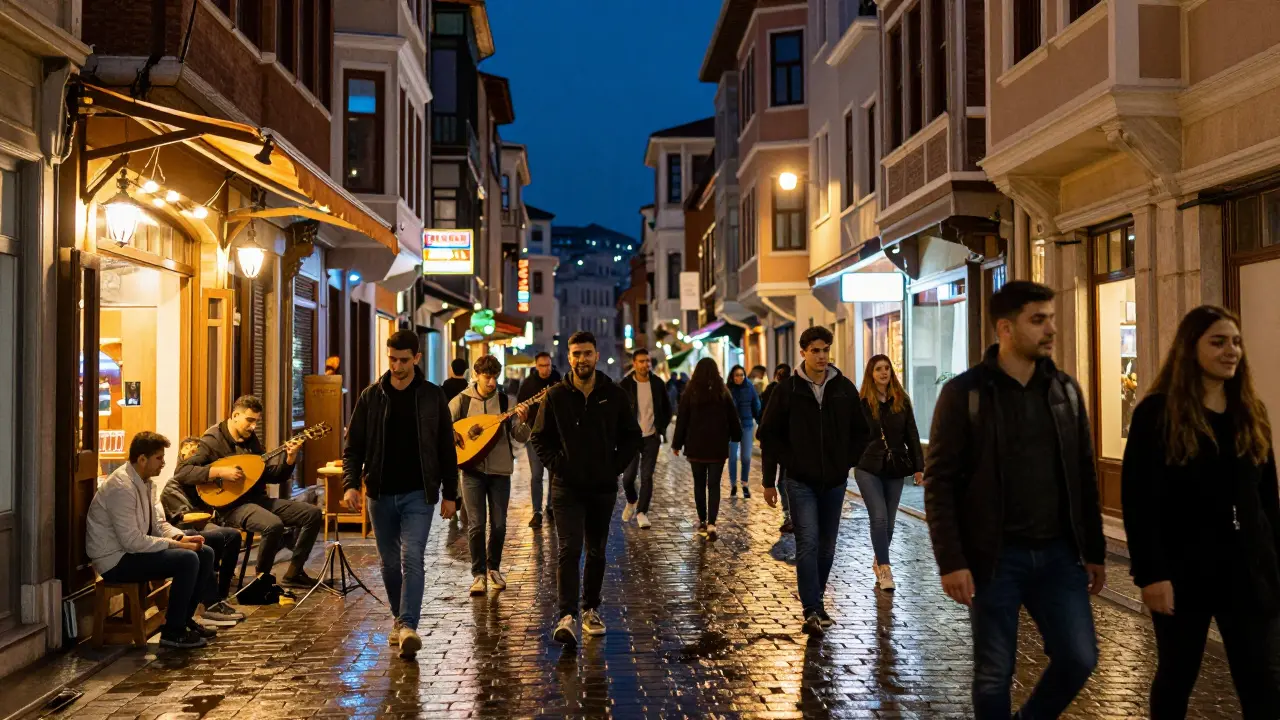
When the sun sets over the Bosphorus, Istanbul doesn’t sleep-it transforms. One moment you’re walking past ancient minarets, the next you’re dancing to live bağlama music in a basement bar where Syrian oud players jam with Russian jazz musicians. This isn’t just a city with nightlife. It’s a living, breathing crossroads where centuries of trade, migration, and rebellion have turned every street corner into a stage.
Where East Meets West, and Beats Collide
Start in Beyoğlu, the heart of Istanbul’s night scene. Here, İstiklal Avenue hums with energy long after midnight. You’ll find Turkish hip-hop artists sampling classical tanbur melodies in one club, while next door, a French expat runs a wine bar with 200 bottles from the Aegean coast. The mix isn’t forced-it’s organic. People from over 150 nationalities live in Istanbul, and their nights reflect that.
Head down to Çiçek Pasajı, the old fish market turned boozy alley. In the 1980s, it was known for cheap rakı and loud arguments. Today, it’s a curated blend: a Lebanese mezze spot next to a Turkish craft beer brewery that uses wild thyme from the Black Sea. The air smells of grilled octopus, smoke from hookahs, and the sharp tang of lemon in a freshly poured glass of raki. No one here is pretending to be something they’re not. That’s the point.
Hidden Gems Beyond the Tourist Zones
Most visitors stick to the well-trodden paths. But if you want to see how Istanbul really lives at night, skip the rooftop bars with $20 cocktails and head to Kadıköy on the Asian side. It’s where locals go after work. The streets here are lined with tiny venues that don’t have signs-just a flickering light or a line of people waiting outside.
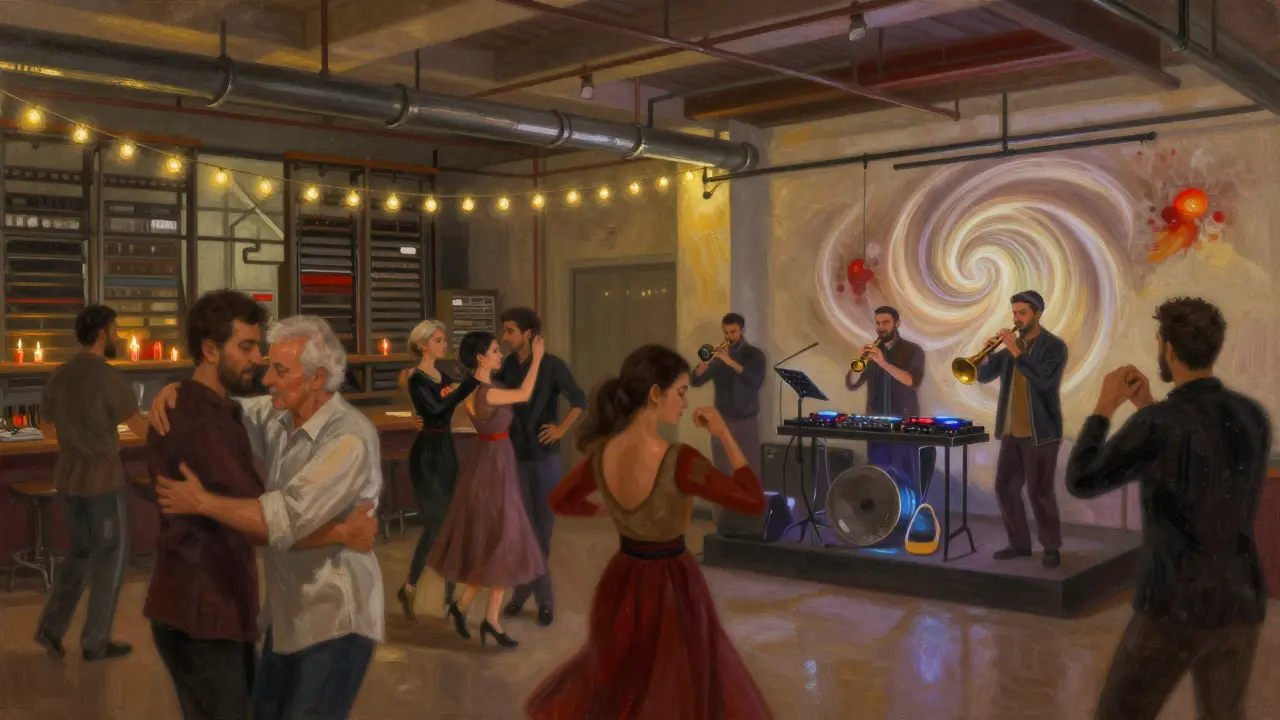
In a converted 1920s printing press, you’ll find Arkaoda, a music space that hosts everything from Kurdish folk ensembles to experimental noise bands. No cover charge. No VIP section. Just a crowd of students, retirees, and Syrian refugees sharing a single table, clinking glasses of ayran and beer. On weekends, the floor fills with people dancing to electronic beats mixed with traditional zurna horns. It’s chaotic. It’s beautiful. It’s real.
Down the street, Bar 1907 serves cocktails made with Turkish herbs like sumac and mastic. The bartender learned his craft in London but uses ingredients from his grandmother’s garden in Anatolia. He’ll tell you, “This isn’t fusion. It’s memory.”
The Music That Moves the City
Istanbul’s nightlife doesn’t just play music-it breathes it. You can hear it in the call to prayer echoing over a techno set in a converted church in Karaköy. You can feel it in the way a Sufi dervish performance in a quiet courtyard in Üsküdar turns into a spontaneous drum circle by midnight.
Don’t miss Aslıhan, a jazz club tucked under a bridge near Galata Tower. It’s been running since 1998 and has hosted legends like Chet Baker and local icons like pianist Ferit Odman. The walls are stained with decades of cigarette smoke and laughter. The chairs are mismatched. The sound system is old. But the music? It’s unmatched. On Tuesday nights, they host “Klasikler,” where musicians play Turkish classics from the 1950s-songs that were banned under military rule. People cry. They dance. They remember.
On Fridays, the underground scene explodes. In a warehouse in Zeytinburnu, you’ll find Barış, a queer-friendly club where DJs blend Arabic pop, Balkan brass, and Detroit techno. It’s not marketed on Instagram. You hear about it from a friend of a friend. And that’s how it should be.
Food That Keeps the Night Alive
Nightlife in Istanbul isn’t just about drinks and dancing. It’s about eating. And no one eats like they do here after midnight.
Head to Çiya Sofrası in Kadıköy. Open until 3 a.m., it’s where you’ll find lamb kebabs stuffed with dried apricots, grilled eggplant with walnut paste, and gözleme filled with spinach and feta. The owner, a Kurdish woman who moved here in the 90s, serves dishes from 12 different regions of Turkey. She doesn’t have a menu. She asks, “What do you feel like tonight?”
Or try Çiğ Köfte stands near the Galata Bridge. Teenagers in hoodies huddle over spicy raw meatballs wrapped in lettuce, eating with their hands. The smell of mint, pomegranate molasses, and chili fills the air. You’ll see Syrian families, Polish backpackers, and Turkish grandmas all sharing the same plastic stools, laughing over the same sticky fingers.
And then there’s the coffee. Not the kind you get in chains. This is Turkish coffee, brewed strong, served with a glass of water, and a piece of lokum. At Karaköy Güllüoğlu, you can order it with a side of poetry. Every Friday, a local poet reads original verses in Turkish, Arabic, and Armenian. People listen. Some cry. No one rushes.
When the Night Turns Quiet
Not every night ends with loud music. Some end with silence.
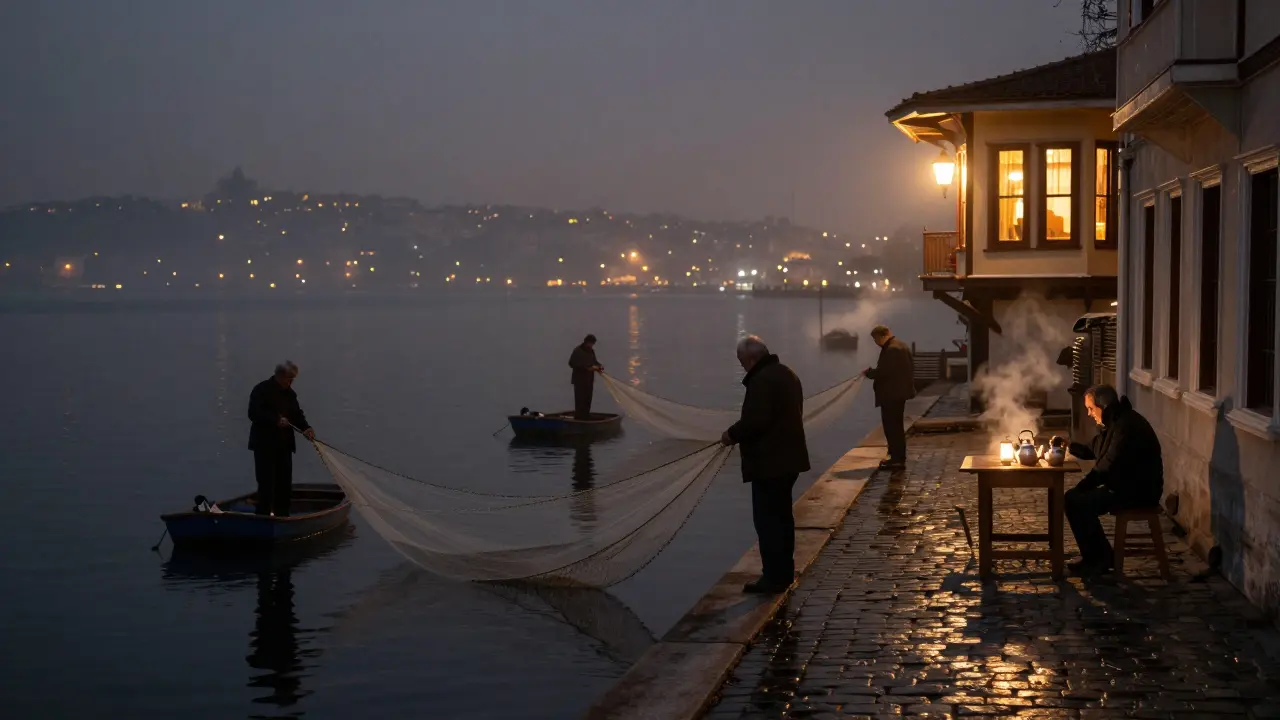
At 4 a.m., walk along the shore of the Golden Horn. You’ll find fishermen casting nets, their lanterns glowing like stars on the water. They’ve been doing this for generations. Some are retired sailors. Others are refugees who fled war and found peace in the rhythm of the tide.
Or slip into one of the old teahouses in Fatih. These aren’t tourist spots. They’re where men play backgammon, sip çay, and talk about everything-politics, love, loss. No one’s in a hurry. The night doesn’t have to end. It just slows down.
What Makes Istanbul’s Nightlife Different?
It’s not the neon lights. Not the fancy cocktails. Not even the history.
It’s the fact that here, your identity doesn’t have to fit a box. A gay Turkish man can dance beside a conservative Muslim grandmother who still remembers the days when music was banned. A Ukrainian refugee can sing in a Kurdish choir. A Chinese student can learn to play the ney from an 80-year-old master.
There’s no single “Istanbul night.” There are dozens. Maybe hundreds. And they all coexist-not in spite of their differences, but because of them.
If you come here looking for a party, you’ll find one. But if you come with your eyes open, you’ll find something deeper: a city that refuses to forget its past, yet never stops reinventing its future.
Is Istanbul nightlife safe for tourists?
Yes, Istanbul’s nightlife is generally safe for tourists, especially in areas like Beyoğlu, Karaköy, and Kadıköy. These neighborhoods are well-lit, patrolled, and full of locals and visitors alike. Avoid isolated streets late at night, and stick to busy areas. As in any major city, watch your belongings and trust your instincts. Most people are welcoming, and many will even offer help if you seem lost.
What’s the best time to visit Istanbul for nightlife?
April to October is ideal. The weather is mild, outdoor venues are open, and festivals like the Istanbul Music Festival and the Istanbul Jazz Festival bring extra energy. Summer months (June-August) are busiest, with longer nights and packed clubs. If you prefer fewer crowds and lower prices, try May or September. Winter nights are quieter, but the hidden gems-like cozy jazz bars and traditional teahouses-still thrive.
Do I need to dress a certain way for Istanbul clubs?
Most clubs in Istanbul are casual. Jeans, a nice top, and clean shoes are fine. Upscale rooftop bars might expect smart-casual attire, but you won’t see strict dress codes like in Paris or New York. In more traditional spots, like teahouses or cultural venues, modest clothing is appreciated but not required. The key is to blend in-dress comfortably, not like you’re on a runway.
Can I find vegetarian or vegan options in Istanbul nightlife spots?
Absolutely. Istanbul has one of the most vibrant plant-based scenes in the region. Many meze bars serve vegan dishes like stuffed grape leaves, lentil soup, and roasted eggplant with tahini. Places like Yeniköy Vegan and Green House in Kadıköy are popular with locals. Even traditional kebab joints now offer vegan alternatives. Don’t hesitate to ask-most staff are used to dietary requests.
How late do places stay open in Istanbul?
Most bars close between 2 a.m. and 3 a.m., but clubs can stay open until 5 a.m. or later, especially on weekends. Some underground venues and jazz spots operate on a “when the music ends” policy. Food spots like Çiya Sofrası and çiğ köfte stands often stay open until 4 a.m. or later. The city doesn’t shut down-it just changes pace.
If you’re planning your next night out, don’t just chase the trend. Listen. Walk. Taste. Let the city surprise you. That’s the only way to truly experience Istanbul after dark.